Art Print Profit Margin Calculator
Enter your costs and desired sale price to calculate your true net profit and margin percentage.
You spent hours perfecting that digital illustration or photograph. You’ve chosen the right paper stock, set up your online store, and finally hit publish. But when you look at the price tag, something feels off. Is $40 too high? Is $15 too low? The real question isn’t just what customers will pay-it’s whether you’re actually making money after all the hidden costs.
Many artists treat pricing like guesswork. They pick a number that sounds nice, hoping it covers their expenses. That approach usually leads to one of two outcomes: selling nothing because the price seems arbitrary, or selling everything but working for pennies. To build a sustainable art business, you need to understand exactly what a good profit margin looks like for art prints.
What is a good profit margin for art prints?
A healthy profit margin for art prints typically ranges between 40% and 60%. This means if a print sells for $100, you should keep $40-$60 as pure profit after covering production, shipping, and platform fees. Margins below 30% often make the effort unsustainable, while margins above 70% may limit your sales volume unless you have a strong brand.
The Baseline: What Percentages Actually Work?
There is no single magic number, but industry standards give us a clear target. For most independent artists, a gross profit margin of 50% is the sweet spot. This allows enough room to absorb unexpected costs, run occasional discounts, and still walk away with a fair wage for your creative labor.
If you are using Print on Demand (POD) services, your margins might naturally sit lower, around 30% to 40%, because the provider handles printing, packaging, and shipping. If you print in-house or use a wholesale printer, you can often push margins higher, toward 60% or more, since you control the base cost. However, higher margins require more upfront investment and logistical work.
Think of it this way: if your total cost to produce and deliver one print is $20, and you sell it for $40, your margin is 50%. If you sell it for $30, your margin drops to 33%. That extra $10 per sale might seem small, but over 100 sales, it’s the difference between paying yourself $1,000 and $3,000.
Breaking Down the Hidden Costs
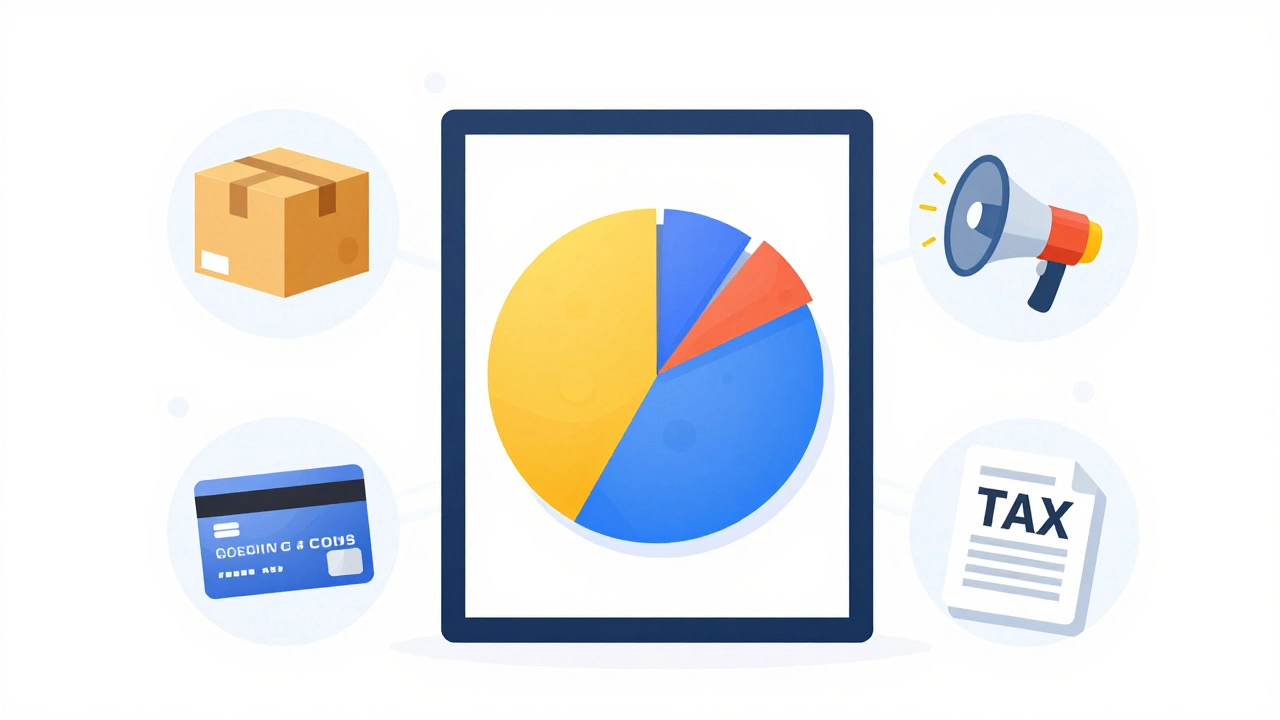
Most artists calculate profit by subtracting only the printing cost from the sale price. This is a dangerous mistake. Your true cost includes several invisible layers that eat into your bottom line before you even see a dollar.
- Production Cost: The actual expense of printing the image on paper or canvas. For POD services, this varies by size and material. A standard 8x10 inch giclée print might cost $8-$12, while a large 24x36 inch canvas could run $30-$50.
- Shipping and Packaging: Even if the customer pays for shipping, you often subsidize part of it to remain competitive. Free shipping is a major conversion driver. If you offer free shipping on orders over $50, you are effectively reducing your margin on every item in that cart.
- Platform Fees: Etsy charges a listing fee ($0.20) plus a transaction fee (6.5%) and payment processing fees (~3% + $0.30). Shopify has monthly subscriptions plus similar payment gateway fees. These can add up to 10-12% of your revenue.
- Marketing and Ads: If you spend money on Instagram ads or Pinterest promotions, that cost must be factored in. A common rule of thumb is to allocate 10-15% of revenue back into marketing.
- Taxes and Licenses: Depending on your location, you may owe sales tax, income tax, or local business licenses. Set aside at least 20-25% of your net profit for taxes.
When you add these together, the “cost” of a $40 print might actually be $22, not $10. Ignoring these factors turns a seemingly profitable sale into a break-even or loss-making event.
Print on Demand vs. In-House Printing
Your choice of fulfillment method drastically changes your margin structure. Let’s compare the two most common approaches for artists in 2026.
| Factor | Print on Demand (POD) | In-House / Wholesale |
|---|---|---|
| Upfront Cost | $0 (no inventory) | High (printer, paper, storage) |
| Per-Unit Cost | Higher ($10-$30+) | Lower ($3-$15) |
| Profit Margin | 30-40% | 50-70% |
| Time Commitment | Low (automated) | High (packing, shipping) |
| Quality Control | Limited (provider dependent) | Full control |
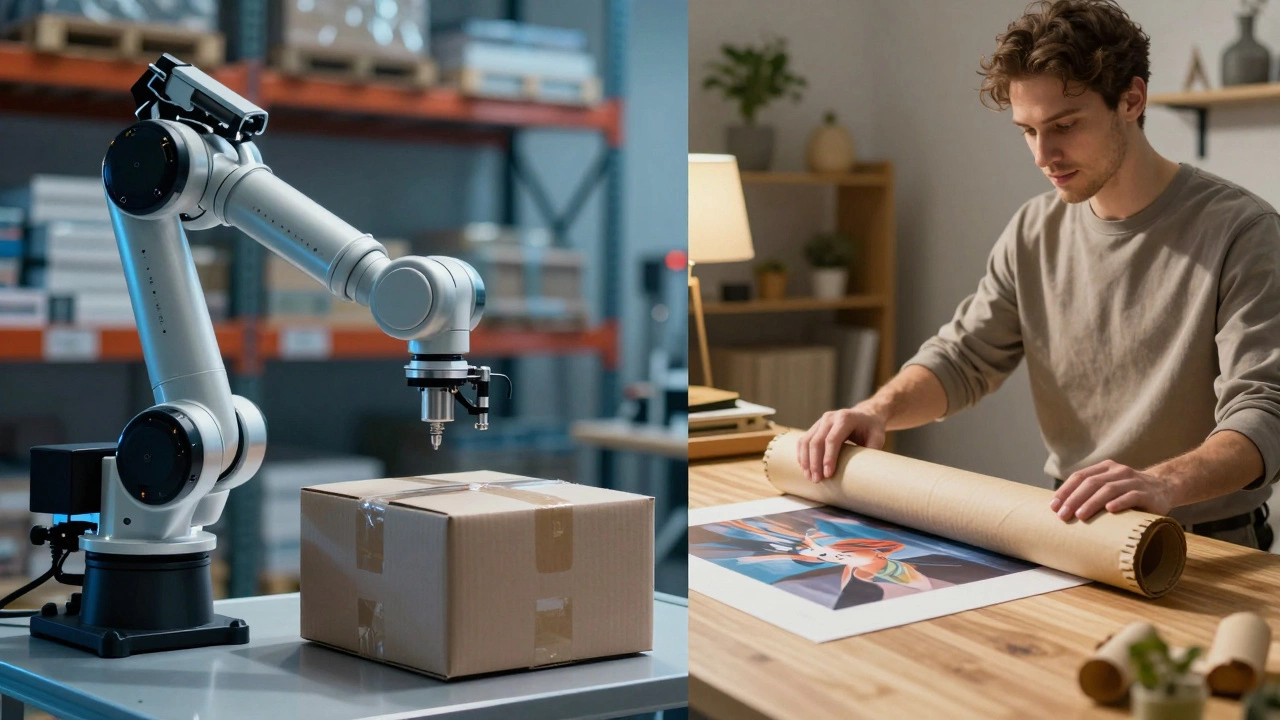
POD services like Printful or Gelato handle everything from printing to shipping. This frees you up to create more art, but you sacrifice margin. In-house printing gives you higher margins and better quality control, but you become a packer and shipper. Many successful artists start with POD to test demand, then switch to in-house for bestsellers once they have the capital for equipment.
Pricing Strategies That Protect Your Margin
Once you know your costs, how do you set the final price? Here are three proven strategies that help maintain healthy margins without scaring away buyers.
1. The Cost-Plus Method
This is the simplest approach. Add up all your costs (production, fees, shipping subsidy) and multiply by a markup factor. For art prints, a markup of 2.5x to 3x is common. If your total cost is $15, sell it for $37.50-$45. This ensures a minimum margin regardless of sales volume.
2. Value-Based Pricing
Instead of focusing on costs, focus on what the customer perceives as valuable. A limited edition signed print from a well-known artist can command a much higher price than an open edition print, even if the production cost is identical. Scarcity and reputation drive value here. You might sell a limited edition for $150 with a 90% margin because the buyer values exclusivity.
3. Tiered Pricing
Offer multiple sizes and formats. Small prints (8x10) act as entry-level products with lower absolute profits but higher volume. Large prints (24x36) or canvases have higher absolute profits and attract serious collectors. By bundling options, you increase the average order value, which dilutes fixed costs like platform fees and improves overall margin.
Common Mistakes That Kill Margins
Even with a solid plan, small errors can erode your profits quickly. Watch out for these traps:
- Underestimating Return Rates: While rare for prints, damaged goods happen. Factor in a 1-2% return or replacement rate in your calculations.
- Ignoring Payment Processing Fees: Those 3% credit card fees add up fast. On a $1,000 month, that’s $30 gone before you touch the money.
- Discounting Too Aggressively: Offering 20% off during holidays might boost sales, but if your margin was already thin, you could be losing money on each sale. Always calculate the breakeven point before running a promo.
- Not Charging for Customization: If customers request custom framing advice or personalized notes, it takes time. Either automate these processes or charge a small premium for bespoke services.
Real-World Example: Calculating Your First Sale
Let’s walk through a realistic scenario. You sell a 16x20 inch archival print on Etsy.
- Sale Price: $65
- Printing Cost (POD): $18
- Shipping Cost: $8 (customer pays $10, you subsidize $2)
- Etsy Fees: ~$4.50 (listing + transaction + payment)
- Total Cost: $30.50
- Net Profit: $34.50
- Profit Margin: 53%
This is a healthy margin. It leaves room for marketing spend and taxes. If you had priced the print at $45, your net profit would drop to $14.50, or a 32% margin. Over 100 sales, that’s $2,000 less in your pocket. The key is to find the price point where customers still say yes, but you don’t lose sleep over the math.
Next Steps: Optimizing Your Art Business
Start by auditing your current prices. Pull data from your last 10 sales and calculate the true net profit per item. If your margin is below 30%, consider raising prices slightly or switching to a cheaper fulfillment option. If you’re using POD, explore negotiating bulk rates if your volume grows. Remember, your art has value. Pricing it correctly isn’t greed-it’s sustainability.
How much should I charge for a 8x10 art print?
For an 8x10 art print, a typical retail price ranges from $25 to $45. This depends on your production cost and brand positioning. If using POD, expect costs around $8-$12, allowing for a $25-$35 price point with a 40-50% margin. Established artists with strong followings can charge $50+ for limited editions.
Is 30% profit margin enough for art prints?
A 30% margin is considered low for art prints. It leaves little room for marketing, returns, or taxes. Aim for at least 40-50% to ensure long-term viability. If you are stuck at 30%, try increasing prices, reducing production costs, or upselling larger formats.
Should I offer free shipping on art prints?
Free shipping can significantly boost conversion rates, especially for smaller prints. However, you must bake the shipping cost into the product price. For example, instead of charging $30 + $5 shipping, charge $35 with free shipping. This keeps your margin intact while appealing to buyers who dislike surprise fees.
How do I calculate my break-even point?
Your break-even point is the number of units you must sell to cover all fixed costs (like website fees or software subscriptions). Divide your total fixed monthly costs by the net profit per print. For example, if your fixed costs are $200 and you make $10 profit per print, you need to sell 20 prints just to break even. Everything after that is pure profit.
Can I raise prices on existing listings?
Yes, you can raise prices at any time. Existing favorites or watchlists won’t automatically update, so loyal fans might notice the change. To minimize backlash, introduce new variants (like different sizes or framed options) at the higher price, or gradually increase prices across the board with a note about improved materials or service.